
Written by Lee Fisher
Lee Fisher has a background in state-level economic development and works extensively with retirement planning, particularly self-directed IRAs and 401(k) rollovers.
Moving retirement funds into a gold IRA can feel complicated at first, especially if you have only used traditional workplace plans. This gold IRA rollover guide can help you clarify the process and understand eligibility to avoid common missteps along the way.
Gold IRAs are often used as a long-term preservation tool rather than a growth engine. Because precious metals tend to behave differently from equities, they may help offset periods of inflation or market stress.
This guide explains why some investors choose to convert a 401(k) to a gold IRA, outlines how the rollover works, and notes practical issues that can arise when holding physical metals in a retirement account.
Rolling over a 401(k) into a gold IRA generally involves transferring funds from one tax-advantaged account to another. Some rollovers move money directly between custodians, while others distribute funds to the account holder first and require redeposit within a specific time frame.
Key Takeaways
- Rolling over a 401(k) into a Gold IRA can help hedge against market volatility, as gold and other precious metals often retain value during economic stress.
- A 401(k) rollover can be completed through a direct rollover, where funds move straight to the Gold IRA, or an indirect rollover, which pays you first but involves stricter IRS rules.
- Choosing an experienced, well-reviewed Gold IRA custodian is critical; they should clearly explain IRS requirements and disclose all fees upfront.
- The IRS allows only specific gold, silver, platinum, and palladium products in a Gold IRA, so selecting approved metals is essential to avoid taxes and penalties.
- Common pitfalls include violating IRS rollover rules, purchasing ineligible metals, and overlooking custodial or storage fees that can reduce returns.
What Is a 401(k) Plan?
A 401(k) plan is a tax-deferred retirement account established under section 401(k) of the Internal Revenue Code. It allows employees to contribute part of their wages before taxes, with income taxes generally owed when funds are withdrawn in retirement.
Many employers offer matching contributions, which can meaningfully boost long-term savings. Contribution limits apply each year, and investment menus are usually set by the plan sponsor. Common options include mutual funds, bond funds, money market funds, stable value funds, and sometimes company stock.
A 401(k) offers several practical advantages, such as automatic payroll contributions, potential employer matching, and tax-deferred growth. Some plans also allow loans under defined conditions. That said, investment choices are often limited to the options selected by the employer, which may not suit every investor’s preferences.
Primary Benefits of a 401(k) Plan May Include
- Automated savings
- Company match
- Tax-deferred growth
- Ability to borrow from the account under specific circumstances
- Various investment options
- Convenience
Can You Own Physical Gold in a Standard 401(k)?
Most standard 401(k) plans do not permit direct ownership of physical gold or silver. Exposure to precious metals is usually limited to paper-based investments, such as mining company stocks or precious metals mutual funds.
Investors who want to hold physical metals typically need to move funds into a different type of account, which is where a gold or silver IRA rollover becomes relevant.
What Is a Gold IRA?
A gold IRA is a form of self-directed individual retirement account that allows investment in certain IRS-approved precious metals instead of traditional assets like stocks or bonds. Eligible metals can include gold, silver, platinum, and palladium that meet specific purity standards.
Unlike funds or shares tied to metal prices, a gold IRA holds physical coins or bars. These assets must be stored at an IRS-approved depository rather than kept by the account holder.
Gold IRAs can be structured as traditional, Roth, or SEP accounts, with tax treatment depending on the type selected.
Why Consider Rolling Over a 401(k) to a Gold IRA?
Converting a part of a 401(k) into a gold IRA is often framed as a way to reduce exposure to market-driven assets and broaden the mix of holdings in a retirement account.
By adding physical gold or other approved precious metals, some investors aim to introduce an asset that tends to respond differently to economic stress than stocks or bonds.

Hedge Against Economic Uncertainty
Gold has historically been viewed as a store of value during periods of rising inflation, geopolitical tension, or broad market declines. While prices can still fluctuate, gold has often retained purchasing power when paper assets come under pressure.
Holding gold inside a retirement account may provide an additional layer of stability during unpredictable economic cycles.
Portfolio Diversification
Diversification is the practice of spreading investments across different asset classes to manage risk.
Precious metals frequently show low correlation with traditional financial markets, meaning they do not always move in the same direction as equities or fixed-income investments.
Including gold in a retirement portfolio may help offset losses during market downturns and smooth overall performance.
Tax Advantages
The tax treatment of a gold IRA depends on the account structure. Contributions to a traditional gold IRA may be tax deductible, subject to income limits and participation in an employer-sponsored plan, and taxes are generally paid when funds are withdrawn.
Roth gold IRAs are funded with after-tax dollars, but qualified withdrawals in retirement are tax free. Each structure comes with its own rules, making it important to align the account type with individual tax circumstances.
Types of Gold IRAs
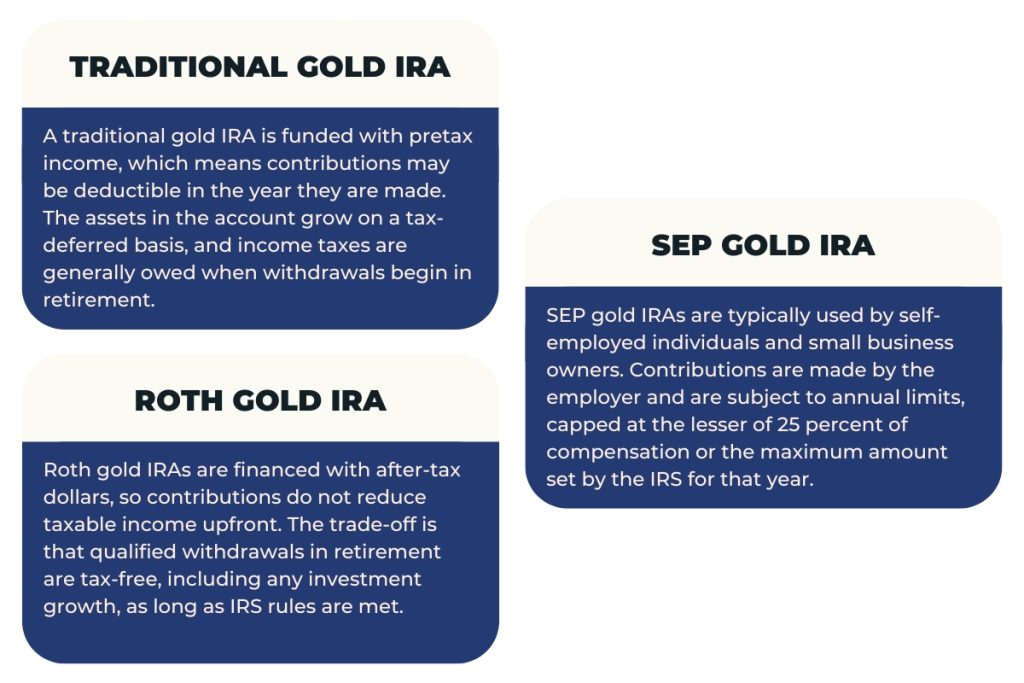
Generally, there are three types of gold IRAs: Traditional, Roth, and SEP gold IRAs. These accounts can be funded through rollovers from existing employer plans (like 401(k)s) or direct transfers from existing IRAs.
Traditional Gold IRA
A traditional gold IRA functions much like a traditional IRA, offering tax-deferred growth while holding IRS-approved precious metals. Taxes are typically due when distributions are taken in retirement.
Roth Gold IRA
A Roth gold IRA uses after-tax contributions. If certain requirements are met, both contributions and investment earnings can be withdrawn tax free later in life.
SEP Gold IRA
A SEP gold IRA is intended for self-employed individuals and small business owners. It allows for higher contribution limits than traditional or Roth IRAs and supports investment in qualifying precious metals, with contributions generally treated as tax deductible.
What Is a 401(k) Gold or Silver Rollover?
A gold or silver rollover involves moving funds from a 401(k) plan into a self-directed precious metals IRA. This most commonly applies to accounts held with a former employer, as active workplace plans often limit or prohibit rollovers while employment continues.
When a 401(k) is no longer tied to a current employer, the balance can typically be transferred into a gold or silver IRA, rolled into a new employer’s plan, or withdrawn as cash, which may trigger taxes and early withdrawal penalties.
Moving funds into a precious metals IRA is usually a straightforward process when dealing with an old 401(k), provided the rollover follows IRS rules.
How to Move a 401(k) to Gold Without Penalties
- Confirm Eligibility for a Rollover
Before starting a rollover, it is important to confirm that your 401(k) plan allows it. Accounts from former employers are usually eligible without restrictions. Plans tied to a current employer follow the rules set by that plan, and many do not permit rollovers until employment ends.
Some plans allow an in-service rollover once you reach a certain age, often 59½, but this is not universal. Outstanding loans can also affect eligibility.
If a loan is not repaid within the required period after leaving an employer, the unpaid balance may be treated as a taxable distribution.
- Choose a Reputable Gold IRA Custodian and a Gold IRA Company
The next step is selecting a gold IRA company and a custodian that supports self-directed IRAs and works with physical precious metals.
A gold IRA company acts as a facilitator and service provider. Your gold IRA company will guide you through the gold IRA rollover process, help you select IRS-approved metals, and coordinate with the custodian and approved depository to ensure the account is set up and managed properly.
The custodian oversees compliance with IRS rules, handles rollover documentation, facilitates metal purchases, and coordinates storage. Typically, gold IRA companies work with their preferred custodians, so you will get matched with one that supports precious metals IRAs.
If you’re looking to open a gold IRA and roll over your 401(k) into physical gold, read our guide on how to choose the best gold IRA company for a 401(k)-to-gold rollover.
When comparing custodians, it helps to look at their experience with precious metals IRAs, their standing with regulators and consumer review platforms, and how clearly they disclose fees.
Costs may include account setup, annual administration, storage, insurance, transaction charges, and pricing spreads on metals.
- Open a Gold IRA Account
Once a custodian is chosen, you open a gold IRA by completing an application and identity verification. The account type should match the tax status of the funds being rolled over.
In many cases, pre-tax 401(k) assets are moved into a traditional gold IRA to maintain tax deferral. Moving pre-tax funds into a Roth gold IRA is usually treated as a taxable conversion and may result in immediate income taxes.
- Initiate the Rollover
With the gold IRA established, the rollover can begin. You can move a 401(k) to gold without penalties by using a direct rollover. In this process, funds move directly from the 401(k) plan to the gold IRA custodian without passing through your hands.
This reduces the chance of errors and helps avoid unintended tax consequences. The plan administrator may send funds electronically or issue a check made payable to the IRA custodian for your benefit. Accurate paperwork is essential so the transaction is reported correctly as a rollover rather than a distribution.
- Select IRS-Approved Precious Metals
After funds are credited to the gold IRA as cash, you direct the custodian to purchase eligible precious metals. The IRS permits only certain bullion coins and bars that meet specific purity standards.
Items marketed as collectibles or numismatic pieces are often excluded, even if they contain gold or silver. Verifying eligibility and pricing before purchasing helps avoid compliance problems and unexpected costs.
- Arrange for Secure Storage
Once the metals are purchased, they are shipped to an IRS-approved depository for storage. The depository holds the assets on behalf of the IRA.
Storage can be segregated, where metals are kept separately, or commingled, where assets are stored with those of other account holders, depending on the option selected and associated fees.
Holding IRA metals personally or storing them at home is generally not allowed and can cause the account to lose its tax-advantaged status.
Direct Gold IRA Rollover vs. Indirect Rollover
A rollover from a 401(k) to a gold IRA can be handled in one of two ways, and the choice affects both complexity and risk.
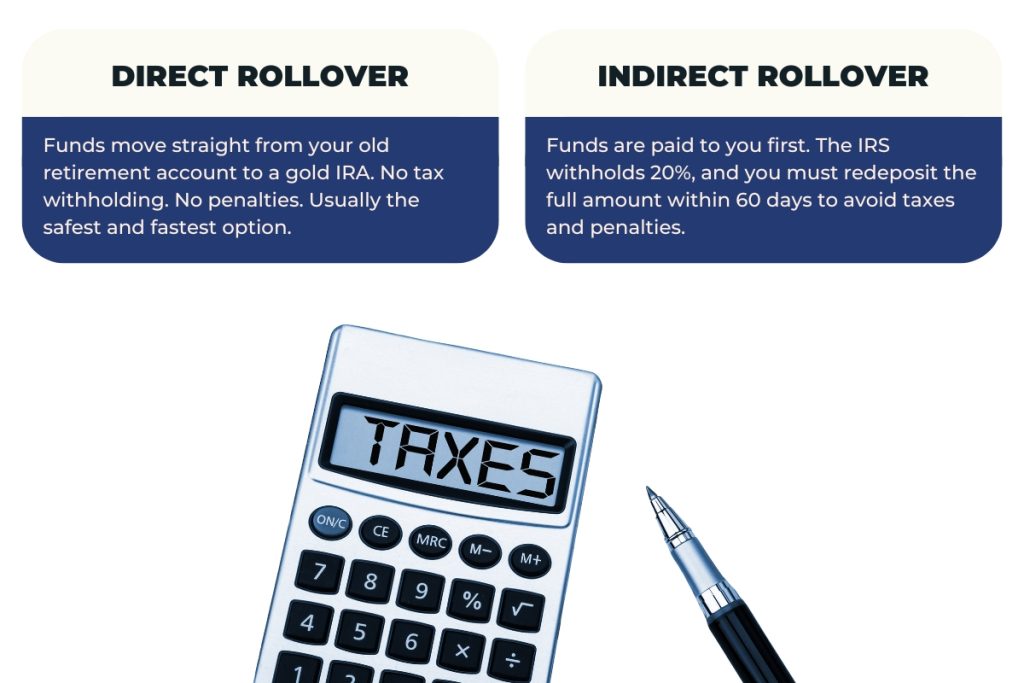
When done correctly through a direct rollover, it is possible to move a 401(k) to gold without triggering taxes or early withdrawal penalties.
Direct Rollover
In a direct rollover, funds move straight from the 401(k) plan to the gold IRA custodian. Direct rollovers avoid taxes and penalties. No taxes are withheld, and there is no 60-day deadline to manage. This method minimizes administrative risk and is often considered the most straightforward approach.

Indirect Rollover
Indirect rollovers require strict compliance. With an indirect rollover, the 401(k) distributes funds to you first. You then have 60 days to deposit the full amount into a gold IRA. Most plans automatically withhold 20% for taxes, even though the entire distribution must be rolled over to avoid taxation.
If the full amount is not deposited within the deadline, the withheld portion may be treated as taxable income and could be subject to early withdrawal penalties if you are under age 59½. Penalties usually apply only when rules are broken.
Because of these requirements, indirect rollovers are typically used only in limited situations where temporary access to funds is necessary and timing can be managed carefully.
Rules and Regulations for Gold IRA Rollovers
Gold IRA rollovers are subject to IRS rules that are intended to protect the tax-advantaged treatment of retirement accounts. Compliance depends on meeting requirements related to eligible metals, contribution rules, and how assets are stored.
Eligible Precious Metals
A gold IRA may hold gold, silver, platinum, and palladium, provided the metals meet minimum purity standards and are produced by approved mints or refiners.
While a small number of widely recognized coins are specifically allowed under IRS guidance, most bullion must satisfy strict fineness requirements.
Items classified as collectibles are generally excluded, even when they are made from otherwise permitted metals.
Contribution Limits
Annual contribution limits apply only to new IRA contributions made from earned income. These limits do not apply to rollovers.
Funds transferred from a 401(k) into a gold IRA can be rolled over in full, regardless of amount, as long as the rollover qualifies under IRS rules. Confusing rollover transfers with annual contributions is a common source of misunderstanding.
Storage Requirements
IRS rules also govern how precious metals are stored. Assets held in a gold IRA must be kept at an IRS-approved depository under the custody of the IRA administrator. The metals are owned by the IRA itself, not the individual account holder, and cannot be stored at home or in a personal safe deposit box.
Storage may be arranged on a segregated basis, where specific metals are kept separate, or on a commingled basis, where assets are pooled by type. Costs and insurance coverage vary depending on the storage option selected.
How to Choose the Best Gold IRA Custodian
The custodian plays a central role in a gold IRA rollover. An experienced provider should be familiar with self-directed IRAs, precious metals transactions, and the reporting requirements involved in rollovers.
Established relationships with approved depositories and metal dealers can help streamline the process. Experience matters, as errors in documentation, reporting, or asset selection can lead to unintended tax consequences.
Fee disclosure is another key consideration. Custodians may charge for account setup, ongoing administration, storage, insurance, transactions, and may also earn compensation through markups on metal purchases.
These costs can differ widely between providers and may affect long-term results. Requesting a complete, written schedule of fees can help clarify the total cost of maintaining the account.
Customer service is also practical to consider. A rollover involves coordination between multiple parties and adherence to specific timelines. Clear communication, consistent guidance, and timely updates from the custodian can reduce administrative issues and help keep the process on track.
Common Mistakes to Avoid
Gold IRAs operate under the same tax rules as other IRAs. Traditional gold IRAs allow tax-deferred growth, with taxes generally owed when distributions are taken.
Roth gold IRAs use after-tax contributions and permit tax-free withdrawals if the required conditions are met. When handled correctly, rollovers do not create a taxable event at the time of transfer.
Problems can arise when rollover rules are not followed. Missing the 60-day deadline on an indirect rollover, failing to roll over the full distribution, or violating custody and storage requirements can cause the transfer to be treated as taxable income. Withdrawals made before age 59½ may also trigger additional penalties unless an exception applies.
Required minimum distributions add another layer of complexity. Because gold IRAs hold physical metals, satisfying RMDs may require selling metals for cash or taking distributions in kind.
Both options involve coordination with the custodian and advance planning. Given these considerations, reviewing the rollover with a tax professional before proceeding is often a prudent step.
Pros and Cons of Investing in a Gold IRA
Investing in a gold IRA comes with a distinct set of advantages and limitations. Understanding both sides can help investors decide whether precious metals fit their retirement strategy.
Benefits of a Gold IRA
Hedge Against Inflation
Gold is commonly viewed as a way to protect purchasing power when inflation rises. When the value of paper currency weakens or prices increase broadly, gold has often held its value over time. For some investors, this makes it appealing as a long-term safeguard within a retirement account.
Portfolio Diversification
Precious metals typically move differently from stocks and bonds. Adding gold to a retirement portfolio can lower overall risk by reducing reliance on traditional financial markets. This diversification may help soften the impact of market swings during periods of volatility.
Long History as a Store of Value
Gold has served as a form of money and wealth preservation for centuries. Its durability, scarcity, and widespread acceptance have supported its role as a long-term store of value across different economic systems and regions.
No Counterparty Risk
Physical gold is not tied to the financial health of a company, government, or borrower. Its value does not depend on earnings reports, debt repayment, or the stability of financial institutions, which sets it apart from many paper-based investments.
Potential Safe-Haven Asset
During times of economic strain or geopolitical uncertainty, demand for gold often increases. Investors may turn to it when confidence in financial markets declines, which is why it is frequently associated with defensive positioning in uncertain conditions.
Downsides of a Gold IRA
No Income Generation
Gold does not pay dividends or interest. Any return depends entirely on changes in its market price, which may be less suitable for investors who rely on steady income from their retirement assets.
Storage and Insurance Costs
A gold IRA requires physical metals to be held in an IRS-approved depository. Storage, insurance, and account administration fees can add ongoing costs that may reduce net returns over time.
Price Volatility
While gold is often considered stable over long periods, its price can move sharply in the short term. Shifts in interest rates, currency movements, and investor sentiment can all influence gold prices.
Less Liquidity Than Stocks or Bonds
Selling physical gold generally takes more time than trading publicly listed securities. Transactions may also involve spreads or dealer fees, which can affect how much an investor ultimately receives.
Opportunity Cost During Strong Equity Markets
Allocating capital to gold can reduce exposure to assets that have historically delivered higher long-term growth, such as stocks. When equity markets perform well, holding gold may lead to slower overall portfolio growth.
Tax Implications of a Gold IRA
Gold IRAs are generally taxed under the same framework as other individual retirement accounts. Depending on the account type, contributions may be deductible, while investment gains grow on a tax-deferred basis.
Withdrawals taken before age 59½ can trigger income taxes and early distribution penalties. Required minimum distributions begin at age 73, and meeting those obligations may be more complicated when the account holds physical metals rather than easily divisible securities.
Cautions About Self-Directed IRAs
Self-directed IRAs allow access to a wider range of investments, but they also place more responsibility on the account holder. The rules governing these accounts are more detailed, and the space has seen aggressive sales tactics and instances of fraud.
Investors should be wary of pitches involving home storage arrangements, non-eligible or collectible coins, promises of guaranteed performance, or pressure to act quickly.
Reducing risk starts with careful verification. Investors should confirm that any metals purchased meet IRA eligibility standards, that storage is provided through an IRS-approved depository, and that all costs are fully disclosed in writing.
Structures that claim to bypass custody rules or limit regulatory oversight deserve extra scrutiny. Taking the time to understand the requirements and compare providers can help prevent avoidable mistakes and unexpected tax consequences.
FAQs
What does rolling over a 401(k) to a gold IRA mean?
Rolling over a 401(k) to a gold IRA involves moving retirement funds from an employer-sponsored plan into a self-directed individual retirement account that can hold IRS-approved physical precious metals.
This can be done through a direct rollover, where the funds transfer straight from the 401(k) plan to the new IRA custodian, or an indirect rollover, where the funds are first distributed to you and must be redeposited into the gold IRA within 60 days to avoid taxes and penalties.
When handled properly, the rollover preserves the tax-advantaged status of the retirement savings while changing the types of assets held.
Are gold IRA contributions tax-deductible?
Whether contributions are deductible depends on the structure of the account and the investor’s tax circumstances.
Contributions to a traditional gold IRA may be deductible, subject to income thresholds and participation in an employer-sponsored retirement plan.
Roth gold IRA contributions are made with after-tax dollars and do not provide an upfront deduction, but qualified withdrawals in retirement are generally tax-free.
Rollover funds are treated differently from new contributions and do not count toward annual contribution limits.
Can I buy gold stocks in a gold IRA?
Gold IRAs are designed to hold physical precious metals, such as qualifying bullion coins and bars that meet IRS requirements.
Securities tied to gold, including mining stocks, exchange-traded funds, or other paper-based investments, are not permitted in these accounts.
Investors seeking exposure to gold-related securities typically use traditional brokerage IRAs, while gold IRAs are reserved for physical metal ownership.
How do gold prices affect my Gold IRA?
The value of a gold IRA reflects the market price of the metals held in the account. Rising gold prices generally increase the account’s value, while price declines can reduce it.
Gold prices are influenced by factors such as interest rate trends, inflation expectations, currency movements, global economic conditions, and investor behavior.
Because gold does not produce income, price changes are the primary source of gains or losses.
How is a gold IRA different from a traditional IRA?
Traditional IRAs usually hold financial assets such as stocks, bonds, mutual funds, or ETFs and are managed through brokerage platforms. A gold IRA is a form of self-directed IRA that holds physical precious metals instead of paper assets.
These accounts require a specialized custodian, storage at an approved depository, and compliance with additional IRS rules related to asset eligibility and custody.
While both account types offer tax advantages, gold IRAs involve more administrative steps and ongoing costs tied to storage and oversight.
Bottom Line
Moving assets from a 401(k) into a gold IRA can change the makeup of a retirement portfolio and add exposure to physical precious metals. The process requires careful attention to fees, tax rules, and custody requirements.
A clear understanding of how gold IRAs work can help investors evaluate whether this approach aligns with their broader retirement strategy.